Your customers
Why do we only notice a customer has stopped ordering at the year end?
By Doug Taylor and Jake Mayell, Co-Founders · Last reviewed 16 October 2026
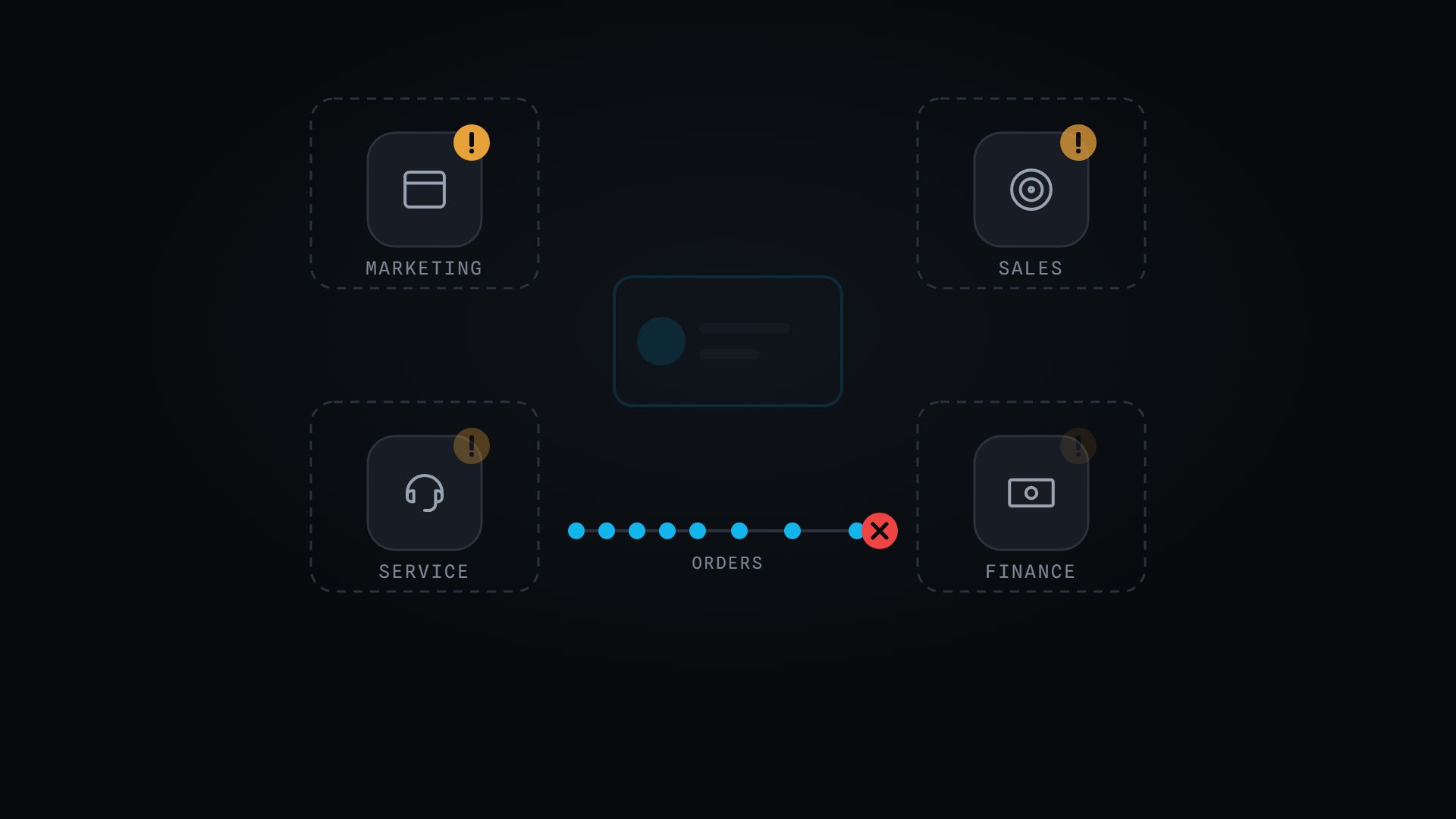
Because the order history sits in the finance system and the relationship sits with the account manager, so nobody sees the whole customer. Joining the orders to the relationship gives you one view of what each customer buys, how often and what's changed, so a slipping customer is spotted in weeks, not months.
Customers who buy again and stay · 1 min
91%
would lose knowledge if a key person left
What the video says
When did you last notice a regular customer had stopped ordering? Often, this doesn't happen until the year end.
The order history sits in the finance system. The relationship sits with the account manager. And nobody is looking at the whole view, or spotting patterns.
So the warning signs pass by, and the cross-sell never happens.
Joining the orders to the relationship gives you one view of each customer: what they buy, how often, and what's changed. A slipping customer is spotted in weeks, not months.
And the right person gets a reason to call while there's still an account to grow or a relationship to save.
Struggling to get customers to buy again and stay? Let's talk.
So what would you like to know next?
How we fix it
What we do
Define what a healthy customer looks like and the early warning signs, decide who owns each account, and design the triggers for cross-sell and win-back across calls, messages and audiences.
Where bad data gets in
Order history that stays in the finance system, inconsistent product categories, and accounts split across several records.
What it breaks further down
Nobody can see what a customer doesn't buy, win-back reaches the wrong people, and account managers walk in without the history.
What moves
Repeat rate, lapsed customers spotted within 90 days, and revenue per customer.
Usually owned by
Commercial Director
An example
Example
Nordoff and Robbins
The challenge. The UK’s music therapy charity was losing regular donors, with supporters spread across two expensive marketing tools and a CRM nobody could find their way round.
What changed. We worked with the fundraising team to bring every supporter onto one platform with one set of permissions, then put the journeys in place that keep supporters giving: welcome, regular giving, legacy stewardship, and re-engagement for those who had drifted.
The result. One view of every supporter, and journeys built to turn one-off gifts into regular ones and bring lapsed donors back.